


Page 27 - DT Vol 15 No 3
P. 27
aesthetics I
             DENTAL TECHNOLOGY, JULY-SEPTEMBER 2025                                                                              27


            CASE III: COMPLICATED CASE WITH DIFFERENT ABUTMENT COLOURS AND LITTLE AVAILABLE SPACE


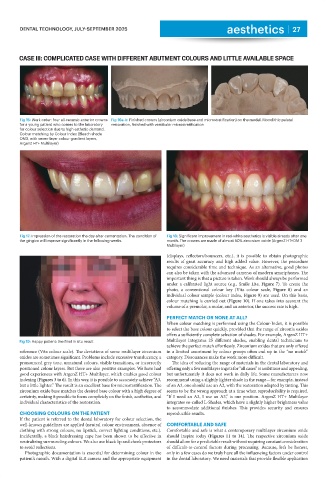
            Fig 15: Work order: four all-ceramic anterior crowns  Fig 16a-b: Finished crowns (zirconium oxide base and microstratification) on the model. Monolithic palatal
            for a young patient who comes to the laboratory   restoration, finished with vestibular microstratification
            for colour selection due to high esthetic demand.
            Colour matching by Colour Index (Bleach shade
            OM3, with seven-layer colour gradient layers,
            ArgenZ HT+ Multilayer)


            Fig 17: Impression of the restoration the day after cementation. The condition of   Fig 18: Significant improvement in red-white aesthetics is visible already after one
            the gingiva will improve significantly in the following weeks.   month. The crowns are made of almost 90% zirconium oxide (ArgenZ HT+OM 3
                                                                           Multilayer)

                                                                           (displays, reflectors/bouncers, etc.), it is possible to obtain photographic
                                                                           results of great accuracy and high added value. However, the procedure
                                                                           requires considerable time and technique. As an alternative, good photos
                                                                           can also be taken with the advanced cameras of modern smartphones. The
                                                                           important thing is that a picture is taken. Work should always be performed
                                                                           under  a  calibrated  light  source  (e.g.,  Smile  Lite,  Figure 7).  To  create  the
                                                                           photo, a conventional colour key (Vita colour scale,  Figure 8) and an
                                                                           individual colour sample (colour index, Figure 9) are used. On this basis,
                                                                           colour matching is carried out (Figure 10). If one takes into account the
                                                                           volume of a premolar, a molar, and an anterior, the success rate is high.

                                                                           PERFECT MATCH OR NONE AT ALL?
                                                                           When colour matching is performed using the Colour-Index, it is possible
                                                                           to select the base colour quickly, provided that the range of zirconia oxides
                                                                           offers a sufficiently complete selection of shades. For example, ArgenZ HT+
            Fig 19: Happy patient: the final in situ result                Multilayer integrates 25 different shades, enabling dental technicians to
                                                                           achieve the perfect match effortlessly. Zirconium oxides that are only offered
            reference (Vita colour scale). The deviations of some multilayer zirconium  in a limited assortment by colour groups often end up in the “no match”
            oxides are sometimes significant. Problems include excessive translucency, a  category. Dissonances make the work more difficult.
            pronounced grey tone, unnatural colours, visible transitions, or incorrectly   The idea of reducing the range of materials in the dental laboratory and
            positioned colour layers. But there are also positive examples. We have had  offering only a few multilayer ingots for “all cases” is ambitious and appealing,
            good experiences with ArgenZ HT+ Multilayer, which enables good colour  but unfortunately it does not work in daily life. Some manufacturers now
            indexing (Figures 3 to 6). In this way, it is possible to accurately achieve “A3,  recommend using a slightly lighter shade in the range—for example, instead
            but a little lighter.” The result is an excellent base for microstratification. The  of an A3, one should use an A2, with the restoration adapted by tinting. This
            zirconium oxide base matches the desired base colour with a high degree of  seems to be the wrong approach at a time when reproducibility is required.
            certainty, making it possible to focus completely on the finish, aesthetics, and  “If I need an A3, I use an A3,” is our position. ArgenZ HT+ Multilayer
            individual characteristics of the restoration.                 integrates so-called L-Shades, which have a slightly higher brightness value
                                                                           to accommodate additional finishes. This provides security and ensures
            CHOOSING COLOURS ON THE PATIENT                                reproducible results.
            If the patient is referred to the dental laboratory for colour selection, the
            well-known guidelines are applied (neutral colour environment, absence of  COMFORTABLE AND SAFE
            clothing with strong colours, no lipstick, correct lighting conditions, etc.).  Comfortable and safe is what a contemporary multilayer zirconium oxide
            Incidentally,  a  black  hairdressing  cape  has  been  shown  to  be  effective  in  should inspire today  (Figures 11 to 14). The respective zirconium oxide
            neutralizing surrounding colours. We also use black lip and cheek protectors  should allow for a predictable result without requiring constant consideration
            to avoid reflections.                                          of difficult-to-control factors during processing. Because, let’s be honest,
               Photographic documentation is essential for determining colour in the  only in a few cases do we truly have all the influencing factors under control
            patient’s mouth. With a digital SLR camera and the appropriate equipment  in the dental laboratory. We need materials that provide flexible application

