


Page 12 - Dental Practice August 2022
P. 12
prosthodontic section


                     WHEN TO SAVE AND WHEN TO EXTRACT


                          A PROTHODONTIST’S PERSPECTIVE


                                                       SACHIN DEEP SINGH


             INTRODUCTION
             One  is  often  faced  with  clinical  situations  of  grossly  decayed
             tooth/teeth. With the success and availability of implant dentistry
             the  most  common  approach  is  to  extract  such  teeth.  There  is
             definitely a lack of understanding of the importance and rational to
             make that extra effort to salvage such situations even for a short
             period.
               This  article  will  explore  such  situations,  attempt  to  create  a
             prognosis  guideline  and  provide  treatment  solutions  for  badly
             mutilated teeth from a prosthodontist’s perspective.
               The advancement in adhesive dentistry has now made it possible
             for us to look at restorability in a completely new light and that will
             remain as the main criteria in looking at various restorative and/or
             prosthetic treatment solutions. The goal of restoration is to have a
             functional,  aesthetic  tooth  which  will  be  able  to  withstand  the
             occlusal loads.
               The  most  important  aspect  of  restoring  grossly  decayed,
             fractured,  mutilated  teeth  is  the  evaluation  of  remaining  tooth  FIG 1  FIG 2
             structure in various aspects. The loss of dental tissue and the weak-
             ening  of  the  remaining  structure  present  a  challenge  in  terms  of
             prosthetic rehabilitation.

             Following parameters must be evaluated individually and together
             in order to access the restorability and longevity of the same.

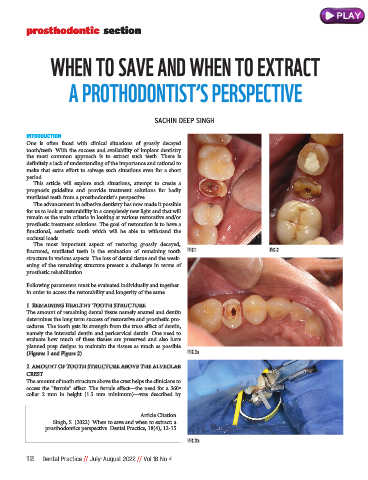
             1. RemAining heAlThy TOOTh STRuCTuRe
             The amount of remaining dental tissue namely enamel and dentin
             determines the long term success of restorative and prosthetic pro-
             cedures. The tooth gets its strength from the truss effect of dentin,
             namely the interaxial dentin and pericervical dentin. One need to
             evaluate  how  much  of  these  tissues  are  preserved  and  also  have
             planned prep designs to maintain the tissues as much as possible
             (Figures 1 and Figure 2).                            FIG 3a

             2. AmOunT OF TOOTh STRuCTuRe AbOve The AlveOlAR
             CReST
             The amount of tooth structure above the crest helps the clinicians to
             access the “ferrule” effect. The ferrule effect—the need for a 360º
             collar  2  mm  in  height  (1.5  mm  minimum)—was  described  by


                                                  Article Citation
                     Singh, S. (2022). When to save and when to extract: a
                   prosthodontics perspective. Dental Practice, 18(4), 12-15

                                                                  FIG 3b

             12   Dental Practice // July-August 2022 // Vol 18 No 4

