


Page 13 - Dental Practice August 2022
P. 13
Sorensen and engelman in 1990. Smaller dimensions are associated
                                                                   with a greater risk of failure.

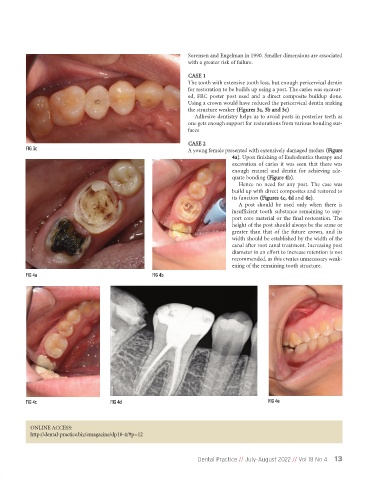
                                                                   CASe 1
                                                                   The tooth with extensive tooth loss, but enough pericervical dentin
                                                                   for restoration to be builds up using a post. The caries was excavat-
                                                                   ed,  FRC  poster  post  used  and  a  direct  composite  buildup  done.
                                                                   using a crown would have reduced the pericervical dentin making
                                                                   the structure weaker (Figures 3a, 3b and 3c)
                                                                     Adhesive dentistry helps us to avoid posts in posterior teeth as
                                                                   one gets enough support for restorations from various bonding sur-
                                                                   faces

                                                                   CASe 2
             FIG 3c                                                A young female presented with extensively damaged molars (Figure
                                                                                 4a). upon finishing of endodontics therapy and
                                                                                 excavation  of  caries  it  was  seen  that  there  was
                                                                                 enough  enamel  and  dentin  for  achieving  ade-
                                                                                 quate bonding (Figure 4b).
                                                                                   hence  no  need  for  any  post.  The  case  was
                                                                                 build up with direct composites and restored to
                                                                                 its function (Figures 4c, 4d and 4e).
                                                                                   A  post  should  be  used  only  when  there  is
                                                                                 insufficient  tooth  substance  remaining  to  sup-
                                                                                 port core material or the final restoration. The
                                                                                 height of the post should always be the same or
                                                                                 greater  than  that  of  the  future  crown,  and  its
                                                                                 width should be established by the width of the
                                                                                 canal after root canal treatment. increasing post
                                                                                 diameter in an effort to increase retention is not
                                                                                 recommended, as this creates unnecessary weak-
                                                                                 ening of the remaining tooth structure.
             FIG 4a                                    FIG 4b


             FIG 4c                      FIG 4d                                              FIG 4e


              Online ACCeSS:
              http://dental-practice.biz/emagazine/dp18-4/#p=12


                                                                      Dental Practice // July-August 2022 // Vol 18 No 4  13

