


Page 14 - Dental Practice August 2022
P. 14
prosthodontic section


             FIG 5a                             FIG 5b                              FIG 5c


             FIG 5d                             FIG 5e                              FIG 5f


             FIG 6a        FIG 6b                         FIG 6c                         FIG 6d

             CASe 3                                               rods. if there is enamel supported by dentin, one has adequate con-
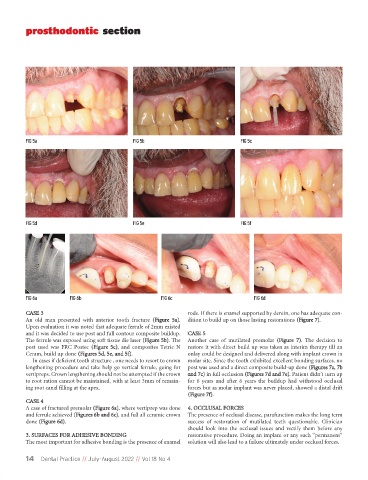
             An  old  man  presented  with  anterior  tooth  fracture  (Figure  5a).  dition to build up on those lasting restorations (Figure 7).
             upon evaluation it was noted that adequate ferrule of 2mm existed
             and it was decided to use post and full contour composite buildup.  CASe 5
             The ferrule was exposed using soft tissue die laser (Figure 5b). The  Another  case  of  mutilated  premolar  (Figure  7).  The  decision  to
             post  used  was  FRC  Postec  (Figure  5c),  and  composites  Tetric  n  restore it with direct build up was taken as interim therapy till an
             Ceram, build up done (Figures 5d, 5e, and 5f).       onlay could be designed and delivered along with implant crown in
               in cases if deficient tooth structure , one needs to resort to crown  molar site. Since the tooth exhibited excellent bonding surfaces, no
             lengthening procedure and take help go vertical ferrule, going for  post was used and a direct composite build-up done (Figures 7a, 7b
             vertipreps. Crown lengthening should not be attempted if the crown  and 7c) in full occlusion (Figures 7d and 7e). Patient didn’t turn up
             to root ration cannot be maintained, with at least 3mm of remain-  for  6  years  and  after  6  years  the  buildup  had  withstood  occlusal
             ing root canal filling at the apex.                  forces but as molar implant was never placed, showed a distal drift
                                                                   (Figure 7f).
             CASe 4
             A case of fractured premolar (Figure 6a), where vertiprep was done  4. OCCluSAl FORCeS
             and ferrule achieved (Figures 6b and 6c), and full all ceramic crown  The presence of occlusal disease, parafunction makes the long term
             done (Figure 6d).                                    success  of  restoration  of  mutilated  teeth  questionable.  Clinician
                                                                  should  look  into  the  occlusal  issues  and  rectify  them  before  any
             3. SuRFACeS FOR ADheSive bOnDing                     restorative procedure. Doing an implant or any such “permanent”
             The most important for adhesive bonding is the presence of enamel  solution will also lead to a failure ultimately under occlusal forces.

             14   Dental Practice // July-August 2022 // Vol 18 No 4

