


Page 38 - DP.qxd
P. 38
implantology  section


                Complications in implant Dentistry


                Angela Cowell and Beatriz Sanchez-inigo highlight the most common complications in
                                implant dentistry and how to prevent them where possible


                                                    Dental implant treatment can significantly   CLASSifiCAtion of
                                                    improve a patient’s function, aesthetics   CompLiCAtionS
                                                    and quality of life. However, this treatment   Arguably,  the  most  comprehensive
                                                    is not without complications. This article   classification of complications is by the
                                                    aims to highlight the most common   International Team for Implantology (ITI)
                                                    complications so they can be recognized by   (Bragger and Heitz-Mayfield, 2015), which
                                                    all practitioners.                 divides these into:
                                                      Being aware of complications at an   • Surgical
                                                    early stage means they can be intercepted   • Biological
                                                    and managed as soon as possible – before   • Aesthetic
                                                    implant failure. In addition, this article   • Hardware
                                                    discusses how to prevent complications   For the purposes of this article, the
                                                    where possible. As Eleanor Roosevelt said:   common implant complications are divided
                                                    ‘Learn from mistakes of others, you can’t   into those occurring early and later in a
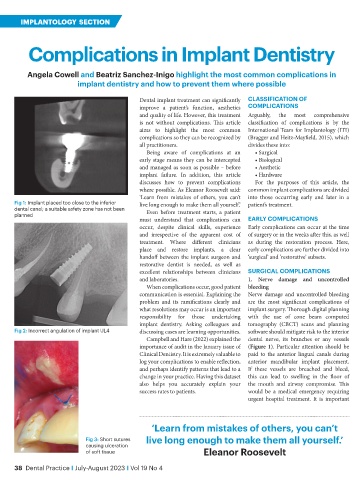
           Fig 1: Implant placed too close to the inferior   live long enough to make them all yourself.’  patient’s treatment.
           dental canal; a suitable safety zone has not been   Even before treatment starts, a patient
           planned
                                                    must understand that complications can   EARLy CompLiCAtionS
                                                    occur, despite clinical skills, experience   Early complications can occur at the time
                                                    and irrespective of the apparent cost of   of surgery or in the weeks after this, as well
                                                    treatment. Where different clinicians   as during the restoration process. Here,
                                                    place and restore implants, a clear   early complications are further divided into
                                                    handoff between the implant surgeon and   ‘surgical’ and ‘restorative’ subsets.
                                                    restorative dentist is needed, as well as
                                                    excellent relationships between clinicians   SuRgiCAL CompLiCAtionS
                                                    and laboratories.                  1. Nerve damage and uncontrolled
                                                      When complications occur, good patient   bleeding
                                                    communication is essential. Explaining the   Nerve damage and uncontrolled bleeding
                                                    problem  and  its  ramifications  clearly  and   are the most significant complications of
                                                    what resolutions may occur is an important   implant surgery. Thorough digital planning
                                                    responsibility for those undertaking   with the use of cone beam computed
                                                    implant dentistry. Asking colleagues and   tomography (CBCT) scans and planning
           Fig 2: Incorrect angulation of implant UL4  discussing cases are learning opportunities.  software should mitigate risk to the interior
                                                      Campbell and Hare (2022) explained the   dental nerve, its branches or any vessels
                                                    importance of audit in the January issue of   (Figure 1). Particular attention should be
                                                    Clinical Dentistry. It is extremely valuable to   paid to the anterior lingual canals during
                                                    log your complications to enable reflection,   anterior mandibular implant placement.
                                                    and perhaps identify patterns that lead to a   If these vessels are breached and bleed,
                                                    change in your practice. Having this dataset   this can  lead to  swelling in  the floor of
                                                    also helps you accurately explain your   the mouth and airway compromise. This
                                                    success rates to patients.         would be a medical emergency requiring
                                                                                       urgent  hospital  treatment.  It  is important


                                                        ‘Learn from mistakes of others, you can’t

                                  Fig 3: Short sutures   live long enough to make them all yourself.’
                                  causing ulceration
                                  of soft tissue                        Eleanor Roosevelt

           38  Dental Practice i July-August 2023 i Vol 19 No 4

