


Page 41 - DP.qxd
P. 41
In  this  article’s  authors’  dental  practice,  a  10-year  implant
                                                                         guarantee is offered, linked to a hygiene maintenance
                                                                         programme. This programme is risk dependent, and patients
                                                                         are seen between one and four times a year, accordingly. This
                                                                         programme is complemented with a pre-treatment phase
                                                                         with the hygiene team. This includes not only mechanical
                                                                         cleaning and disease control, but also a risk assessment
                                                                         (plaque control, medical conditions, smoking habit), and
                                                                         grading of the complexity of implant treatment. Thorough
                                                                         oral hygiene instruction is given, and the maintenance
                                                                         programme explained.
                                                                           After an implant restoration is fitted, the patient has an
                                                                         appointment with the hygiene team to take baseline probing
                                                                         measurements, and to demonstrate how best to clean their
                                                                         new restoration. Any maintenance programme such as this
                                                                         will reduce the possibility of late complications, by reducing
                                                                         risk factors but also identifying problems at an early stage.
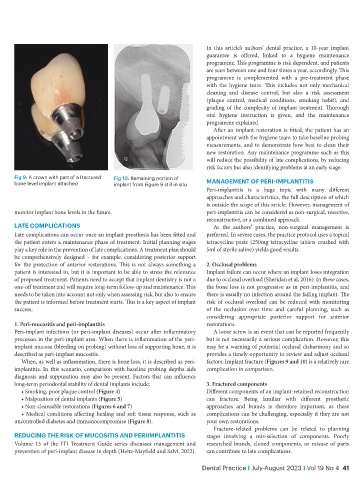
           Fig 9: A crown with part of a fractured   Fig 10: Remaining portion of
           bone level implant attached     implant from Figure 9 still in situ  management of peRi-impLantitis
                                                                         Peri-implantitis  is  a  huge  topic  with  many  different
                                                                         approaches and characteristics, the full description of which
                                                                         is outside the scope of this article. However, management of
           monitor implant bone levels in the future.                    peri-implantitis can be considered as non-surgical, resective,
                                                                         reconstructive, or a combined approach.
           Late compLications                                              At the authors’ practice, non-surgical management is
           Late complications can occur once an implant prosthesis has been fitted and   preferred. In severe cases, the practice protocol uses a topical
           the patient enters a maintenance phase of treatment. Initial planning stages   tetracycline  paste  (250mg  tetracycline  tablets  crushed  with
           play a key role in the prevention of late complications. A treatment plan should   5ml of sterile saline) yields good results.
           be comprehensively designed – for example, considering posterior support
           for  the  protection  of  anterior  restorations.  This  is  not  always  something  a   2. Occlusal problems
           patient is interested in, but it is important to be able to stress the relevance   Implant failure can occur where an implant loses integration
           of proposed treatment. Patients need to accept that implant dentistry is not a   due to occlusal overload (Sheridan et al, 2016). In these cases,
           one-off treatment and will require long-term follow-up and maintenance. This   the bone loss is not progressive as in peri-implantitis, and
           needs to be taken into account not only when assessing risk, but also to ensure   there is usually no infection around the failing implant. The
           the patient is informed before treatment starts. This is a key aspect of implant   risk of occlusal overload can be reduced with monitoring
           success.                                                      of the occlusion over time and careful planning, such as
                                                                         considering  appropriate  posterior  support  for  anterior
           1. Peri-mucositis and peri-implantitis                        restorations.
           Peri-implant infections (or peri-implant diseases) occur after inflammatory   A loose screw is an event that can be reported frequently
           processes in the peri-implant area. When there is inflammation of the peri-  but is not necessarily a serious complication. However, this
           implant mucosa (bleeding on probing) without loss of supporting bone, it is   may be a warning of potential occlusal disharmony and so
           described as peri-implant mucositis.                          provides a timely opportunity to review and adjust occlusal
              When, as well as inflammation, there is bone loss, it is described as peri-  factors. Implant fracture (Figures 9 and 10) is a relatively rare
           implantitis. In this scenario, comparison with baseline probing depths aids   complication in comparison.
           diagnosis and suppuration may also be present. Factors that can influence
           long-term periodontal stability of dental implants include:   3. Fractured components
              • Smoking, poor plaque control (Figure 4)                  Different components of an implant-retained reconstruction
              • Malposition of dental implants (Figure 5)                can fracture. Being familiar with different prosthetic
              • Non-cleansable restorations (Figures 6 and 7)            approaches and brands is therefore important, as these
              •  Medical  conditions  affecting  healing  and  soft  tissue  response,  such  as   complications can be challenging, especially if they are not
           uncontrolled diabetes and immunocompromise (Figure 8).        your own restorations.
                                                                           Fracture-related problems can be related to planning
           Reducing the Risk of mucositis and peRiimpLantitis            stages involving a mis-selection of components. Poorly
           Volume 13 of the ITI Treatment Guide series discusses management and   researched brands, cloned components, or misuse of parts
           prevention of peri-implant disease in depth (Heitz-Mayfield and Salvi, 2022).   can contribute to late complications.

                                                                         Dental Practice i July-August 2023 i Vol 19 No 4  41

