


Page 39 - DP.qxd
P. 39
to explain to patients when you expect
                                                                                      full sensation to  return  following  the
                                                                                      administration of local anaesthetic. Should
                                                                                      the patient experience numbness beyond
                                                                                      this, they should be instructed to contact the
                                                                                      practice immediately. However, as normal
                                                                                      postoperative  swelling  develops, patients
                                                                                      can also feel this as a numb sensation and,
                                                                                      therefore, it is important to be able to
                                                                                      distinguish between the two. A phone call
                                                                                      to patients the day after surgery and access
                                                                                      to an out-of-hours service is an important
                                                                                      part of postoperative care.

                                                                                      2. Incorrect placement of implant
                                                                                      Implant success is dependent upon accurate
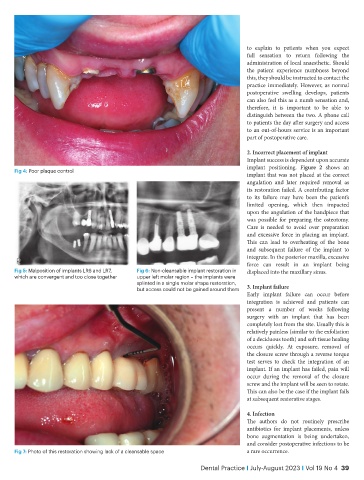
                                                                                      implant positioning.  Figure 2 shows an
           Fig 4: Poor plaque control
                                                                                      implant that was not placed at the correct
                                                                                      angulation and later required removal as
                                                                                      its restoration failed. A contributing factor
                                                                                      to its failure may have been the patient’s
                                                                                      limited opening, which then impacted
                                                                                      upon the angulation of the handpiece that
                                                                                      was possible for preparing the osteotomy.
                                                                                      Care is needed to avoid over preparation
                                                                                      and excessive force in placing an implant.
                                                                                      This  can  lead  to  overheating  of  the  bone
                                                                                      and subsequent failure of the implant to
                                                                                      integrate. In the posterior maxilla, excessive
                                                                                      force can result in  an implant being
           Fig 5: Malposition of implants LR6 and LR7,   Fig 6: Non-cleansable implant restoration in   displaced into the maxillary sinus.
           which are convergent and too close together  upper left molar region – the implants were
                                                   splinted in a single molar shape restoration,
                                                   but access could not be gained around them  3. Implant failure
                                                                                      Early implant failure can occur before
                                                                                      integration is achieved and patients can
                                                                                      present  a  number  of  weeks  following
                                                                                      surgery with an implant that has been
                                                                                      completely lost from the site. Usually this is
                                                                                      relatively painless (similar to the exfoliation
                                                                                      of a deciduous tooth) and soft tissue healing
                                                                                      occurs quickly. At exposure, removal of
                                                                                      the closure screw through a reverse torque
                                                                                      test  serves  to  check  the  integration  of  an
                                                                                      implant. If an implant has failed, pain will
                                                                                      occur during the removal of the closure
                                                                                      screw and the implant will be seen to rotate.
                                                                                      This can also be the case if the implant fails
                                                                                      at subsequent restorative stages.

                                                                                      4. Infection
                                                                                      The authors do not routinely prescribe
                                                                                      antibiotics for implant placements, unless
                                                                                      bone augmentation is being undertaken,
                                                                                      and consider postoperative infections to be
           Fig 7: Photo of this restoration showing lack of a cleansable space        a rare occurrence.

                                                                        Dental Practice i July-August 2023 i Vol 19 No 4  39

