


Page 40 - DP.qxd
P. 40
implantology  section


                                                                                          5. Soft tissue problems
                                                                                          Pain can result from non-resorbable
                                                                                          sutures that are cut too short, as they
                                                                                          can be sharp and irritate the adjacent
                                                                                          tissues (Figure 3). However, resorbable
                                                                                          sutures are not a suitable alternative as
                                                                                          they tend to attract plaque. Incisions
                                                                                          should be closed with tension-free
                                                                                          suturing,  otherwise exposure of the
                                                                                          membrane used in bone augmentation
                                                                                          can occur and granulation tissue forms.
                                                                                          This can lead to failure of the bone
                                                                                          material and infection.

                                                                                          RestoRative complications
                                                                                          1.  Problems  with   temporary
                                                                                          restorations
                                                                                          It is essential that a patient’s temporary
                                                                                          restoration does not impinge on the
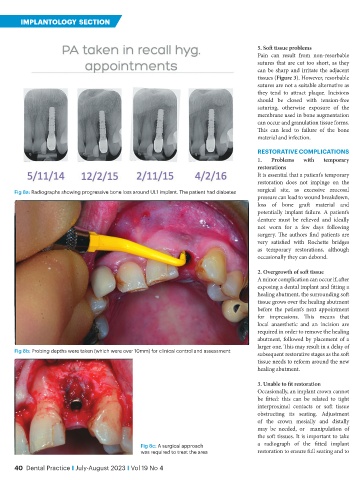
           Fig 8a: Radiographs showing progressive bone loss around UL1 implant. The patient had diabetes  surgical site, as excessive mucosal
                                                                                          pressure can lead to wound breakdown,
                                                                                          loss of bone graft material and
                                                                                          potentially implant failure. A patient’s
                                                                                          denture must be relieved and ideally
                                                                                          not worn for a few days following
                                                                                          surgery. The authors find patients are
                                                                                          very satisfied with Rochette bridges
                                                                                          as temporary restorations, although
                                                                                          occasionally they can debond.

                                                                                          2. Overgrowth of soft tissue
                                                                                          A minor complication can occur if, after
                                                                                          exposing a dental implant and fitting a
                                                                                          healing abutment, the surrounding soft
                                                                                          tissue grows over the healing abutment
                                                                                          before the patient’s next appointment
                                                                                          for  impressions. This  means  that
                                                                                          local anaesthetic and an incision are
                                                                                          required in order to remove the healing
                                                                                          abutment, followed by placement of a
                                                                                          larger one. This may result in a delay of
           Fig 8b: Probing depths were taken (which were over 10mm) for clinical control and assessment
                                                                                          subsequent restorative stages as the soft
                                                                                          tissue needs to reform around the new
                                                                                          healing abutment.

                                                                                          3. Unable to fit restoration
                                                                                          Occasionally, an implant crown cannot
                                                                                          be fitted: this can be related to tight
                                                                                          interproximal contacts or soft tissue
                                                                                          obstructing its seating. Adjustment
                                                                                          of the crown mesially and distally
                                                                                          may be needed, or  manipulation of
                                                                                          the soft tissues. It is important to take
                                                    Fig 8c: A surgical approach           a radiograph of the fitted implant
                                                    was required to treat the area        restoration to ensure full seating and to
           40  Dental Practice i July-August 2023 i Vol 19 No 4

