


Page 42 - DP.qxd
P. 42
implantology  section


           Service evaluation of implant-related                  •  Campbell C, Hare K (2022) Utilising audit in clinical practice.
           complicationS                                            Clinical Dentistry 2(1): 12-14
           All the terms described so far in this article are useful for retrospective   •  Heitz-Mayfield LJA, Salvi GE (2022) ITI Treatment Guide.
           classification of complications, but it is through gathering data from   Volume 13. Prevention and management of peri-implant diseases.
           your own practice that you can begin to proactively recognize potential   Quintessence Publishing, Berlin Sheridan RA, Decker AM, Plonka
           areas for concern and consider any preventive action.    AB, Wang HL (2016) The role of occlusion in implant therapy: a
              In the last year, more than 500 implants were placed at the authors’   comprehensive updated review. Implant Dent 25: 829-838
           practice. They also accepted many referrals for problems with existing
           implants that had been placed outside the clinic, thus expanding
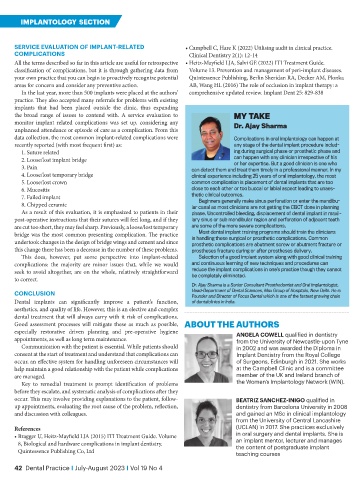
           the broad range of issues to contend with. A service evaluation to     MY TAKE
           monitor implant related complications was set up, considering any
           unplanned attendance or episode of care as a complication. From this   Dr. Ajay Sharma
           data collection, the most common implant-related complications were    Complications in oral implantology can happen at
           recently reported (with most frequent first) as:                       any stage of the dental implant procedure includ-
              1. Suture related                                                   ing during surgical phase or prosthetic phase and
              2. Loose/lost implant bridge                                        can happen with any clinician irrespective of his
                                                                                  or her expertise. But a good clinician is one who
              3. Pain                                               can detect them and treat them timely in a professional manner. In my
              4. Loose/lost temporary bridge                        clinical experience including 25 years of oral implantology, the most
              5. Loose/lost crown                                   common complication is placement of dental implants that are too
              6. Mucositis                                          close to each other or too buccal or labial aspect leading to unaes-
              7. Failed implant                                     thetic clinical outcomes.
                                                                       Beginners generally make sinus perforation or enter the mandibu-
              8. Chipped ceramic                                    lar canal as most clinicians are not getting the CBCT done in planning
              As a result of this evaluation, it is emphasized to patients in their   phase. Uncontrolled bleeding, displacement of dental implant in maxil-
           post-operative instructions that their sutures will feel long, and if they   lary sinus or sub mandibular region and perforation of adjacent teeth
           are cut too short, they may feel sharp. Previously, a loose/lost temporary   are some of the more severe complications.
           bridge was the most common presenting complication. The practice   Most dental implant training programs should train the clinicians
           undertook changes in the design of bridge wings and cement and since   in handling these surgical or prosthetic complications. Common
                                                                    prosthetic complications are abutment screw or abutment fracture or
           this change there has been a decrease in the number of these problems.  prostheses fracture during or after prostheses delivery.
              This does, however, put some perspective into implant-related   Selection of a good implant system along with good clinical training
           complications: the majority are minor issues that, while we would   and continuous learning of new techniques and procedures can
           seek to avoid altogether, are on the whole, relatively straightforward   reduce the implant complications in one’s practice though they cannot
           to correct.                                              be completely eliminated.
                                                                    Dr. Ajay Sharma is a Senior Consultant Prosthodontist and Oral Implantologist,
           concluSion                                               Head-Department of Dental Sciences, Max Group of Hospitals, New Delhi. He is
                                                                    Founder and Director of Focus Dental which is one of the fastest growing chain
           Dental implants can significantly improve a patient’s function,   of dentalclinics in India.
           aesthetics, and quality of life. However, this is an elective and complex
           dental treatment that will always carry with it risk of complications.
           Good assessment processes will mitigate these as much as possible,   aBoUt tHe aUtHoRs
           especially restorative driven planning and pre-operative hygiene        anGela coWell qualified in dentistry
           appointments, as well as long term maintenance.                         from the University of Newcastle-upon Tyne
              Communication with the patient is essential. While patients should   in 2002 and was awarded the Diploma in
           consent at the start of treatment and understand that complications can   Implant Dentistry from the Royal College
           occur, an effective system for handling unforeseen circumstances will   of Surgeons, Edinburgh in 2021. She works
           help maintain a good relationship with the patient while complications   at the Campbell Clinic and is a committee
           are managed.                                                            member of the UK and Ireland branch of
              Key to remedial treatment is prompt identification of problems       the Women’s Implantology Network (WIN).
           before they escalate, and systematic analysis of complications after they
           occur. This may involve providing explanations to the patient, follow-  BeatriZ SancHeZ-iniGo qualified in
           up appointments, evaluating the root cause of the problem, reflection,   dentistry from Barcelona University in 2008
           and discussion with colleagues.                                         and gained an MSc in clinical implantology
                                                                                   from the University of Central Lancashire
           References                                                              (UCLAN) in 2017. She practices exclusively
           •  Bragger U, Heitz-Mayfield LJA (2015) ITI Treatment Guide. Volume     in oral surgery and dental implants. She is
             8, Biological and hardware complications in implant dentistry.        an implant mentor, lecturer and manages
                                                                                   the content of postgraduate implant
             Quintessence Publishing Co, Ltd                                       teaching courses
           42  Dental Practice i July-August 2023 i Vol 19 No 4

