


Page 26 - DP20-2.qxd
P. 26
implantology  section


                          A Comprehensive Analysis of


                  Digital vs. Conventional Techniques


                                   in Dental Implantology


                                   Domenico Benagiano DDS and Claudia Salerno DDS


           In this article we show a clinical case of implant rehabilitation prosthesis of the lower arch through
           a fully digital CAD-CAM workflow. We opted to carry out a cobalt-chromium-ceramic rehabilitation
            due to the structural and aesthetic benefits of this combination confirmed by decades of clinical
                case studies. The technologies available for dental units, dental laboratories involved and
                       production centres allowed us to apply the fully digital workflow at each step.


           InTroDuCTIon
           The analogue or conventional prosthesisation on implants requires
           quite a few steps like taking an alginate impression, creating an
           individual impression tray, second impression registration session
           with implant transfer using the individual impression tray and silicone
           material and face-bow registration, development of the cast or resin
           model with similar implants, fitting in articulator, diagnostic waxing,
           position test in the oral cavity, conversion of the diagnostic waxing
           in small structure, production of this structure through lost-wax
           casting technique, structure test in the oral cavity, biscuit test, then
           finalisation and delivery. Compared to the traditional method, the
           fully digital technique involves fewer steps. It starts with scanning the
           mouth to create a digital impression, then designing the final anatomy
           on a computer, and finally, producing it using a computer-controlled
           milling machine. The fit of the structure is checked on the implants,
           and if needed, adjustments are made. After ensuring everything fits
           well, the final anatomy is created, which can be used temporarily until
           the permanent one is ready. This temporary anatomy can even be
           adjusted for functionality before being scanned again to finalize the
           process.
              This information is then sent to the laboratory, the final prosthesis
           is made using the CAD-CAM technology in compliance with the
           functional occlusal plane, ensuring delivery of the finished and already
           functionalised work.
              During the process, the dentist and lab work closely together. The
           dentist tests the fit and function using cost-effective mock-ups that
           mimic the final prosthesis. This way, any adjustments can be made
           without delaying the lab’s work. Changes are communicated digitally
           between the dentist and the lab, ensuring a smooth and uninterrupted
           workflow. This allows the patient to use temporary mock-ups until the
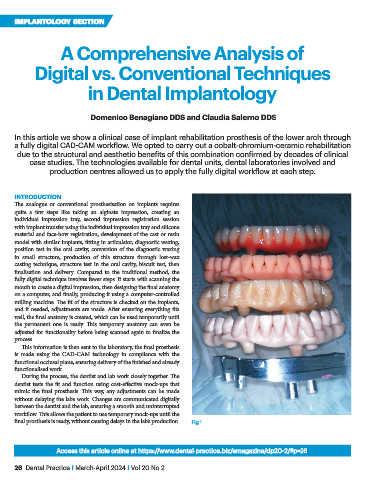
           final prosthesis is ready, without causing delays in the lab’s production.  Fig 1


                         Access this article online at https://www.dental-practice.biz/emagazine/dp20-2/#p=26

           26  Dental Practice I March-April 2024 I Vol 20 No 2

