


Page 31 - DP20-2.qxd
P. 31
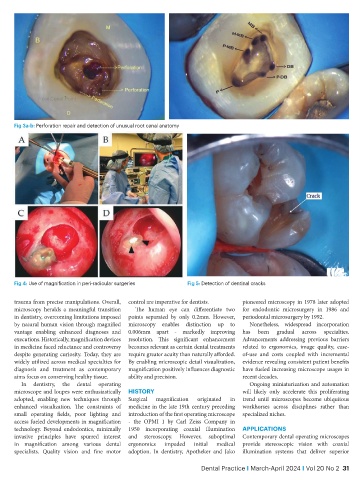
Fig 3a-b: Perforation repair and detection of unusual root canal anatomy


           Fig 4: Use of magnification in peri-radicular surgeries  Fig 5: Detection of dentinal cracks

           trauma from precise manipulations. Overall,   control are imperative for dentists.  pioneered microscopy in 1978 later adopted
           microscopy heralds a meaningful transition   The human eye can differentiate two   for endodontic microsurgery in 1986 and
           in dentistry, overcoming limitations imposed   points separated by only 0.2mm. However,   periodontal microsurgery by 1992.
           by natural human vision through magnified   microscopy enables distinction up to   Nonetheless, widespread incorporation
           vantage enabling enhanced diagnoses and   0.006mm apart - markedly improving   has  been  gradual  across  specialties.
           executions. Historically, magnification devices   resolution. This significant enhancement   Advancements addressing previous barriers
           in medicine faced reluctance and controversy   becomes relevant as certain dental treatments   related to ergonomics, image quality,  ease-
           despite generating curiosity. Today, they are   require greater acuity than naturally afforded.   of-use and costs coupled with incremental
           widely utilized across medical specialties for   By enabling microscopic detail visualization,   evidence revealing consistent patient benefits
           diagnosis  and  treatment  as  contemporary   magnification positively influences diagnostic   have fueled increasing microscope usages in
           aims focus on conserving healthy tissue.  ability and precision.          recent decades.
              In dentistry, the dental operating                                       Ongoing miniaturization and automation
           microscope and loupes were enthusiastically   HiSTORY                     will likely only accelerate this proliferating
           adopted, enabling new techniques through   Surgical  magnification  originated  in  trend until microscopes become ubiquitous
           enhanced visualization. The constraints of   medicine in the late 19th century preceding   workhorses across disciplines rather than
           small operating fields, poor lighting and   introduction of the first operating microscope   specialized niches.
           access fueled developments in magnification   - the OPMI 1 by Carl Zeiss Company in
           technology. Beyond endodontics, minimally   1950 incorporating coaxial illumination   APPLiCATiONS
           invasive principles have spurred interest   and stereoscopy. However, suboptimal   Contemporary dental operating microscopes
           in magnification among various dental   ergonomics  impeded  initial  medical  provide stereoscopic vision with coaxial
           specialists. Quality vision and fine motor   adoption. In dentistry, Apotheker and Jako   illumination  systems  that  deliver  superior

                                                                       Dental Practice i March-April 2024 i Vol 20 No 2  31

