


Page 30 - DP20-2.qxd
P. 30
MAGNIFICATION seCTION


              ZOOMING IN: THE TRANSFORMATIVE


                       POWER OF MAGNIFICATION IN


                                    MODERN DENTISTRY


                                             U.S. Krishna Nayak and Raksha Bhat


           INTRODUCTION
           The evolution of microdentistry has
           necessitated  enhanced  operating  site
           visualization for dentists to enable diagnoses
           at early stages and interventions at higher
           precision.  Magnification  devices  upgrade
           narrow visual faculties imposed by natural
           limitations to transform visibility and
           accessibility. Thereby, treatment planning
           and executions are dramatically upgraded
           across specialties. Reported benefits span
           across multiple facets - from conservative
           caries excavations preserving tooth structure,
           to reduced trauma and faster healing in
           periodontal  plastic  microsurgeries,  to
           shortened recovery times after microscopic
           suturing  and  anastomoses  of  fine
           vasculature and nerves during maxillofacial
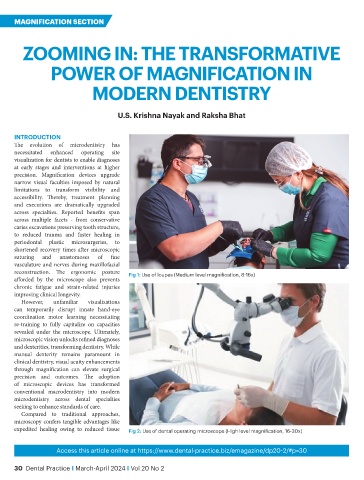
           reconstruction. The ergonomic posture   Fig 1: Use of loupes (Medium level magnification, 8-16x)
           afforded by the microscope also prevents
           chronic fatigue and strain-related injuries
           improving clinical longevity.
              However,  unfamiliar  visualizations
           can temporarily disrupt innate hand-eye
           coordination motor learning necessitating
           re-training  to  fully  capitalize  on capacities
           revealed under the microscope. Ultimately,
           microscopic vision unlocks refined diagnoses
           and dexterities, transforming dentistry. While
           manual dexterity remains paramount in
           clinical dentistry, visual acuity enhancements
           through magnification can elevate surgical
           precision and outcomes. The adoption
           of microscopic devices has transformed
           conventional macrodentistry into modern
           microdentistry across dental specialties
           seeking to enhance standards of care.
              Compared to traditional approaches,
           microscopy confers tangible advantages like
           expedited healing owing  to  reduced  tissue   Fig 2: Use of dental operating microscope (High level magnification, 16-30x)


                         Access this article online at https://www.dental-practice.biz/emagazine/dp20-2/#p=30

           30  Dental Practice I March-April 2024 I Vol 20 No 2

