


Page 22 - DP20-2.qxd
P. 22
Aesthetic dentistry section


                         ROADMAP TO SEAMLESS


                       ANTERIOR RESTORATIONS


                                                          Sanah Sayed


           OVERVIEW
           Composite  dental  materials  are  a  versatile  and  widely  used  class
           of restorative  materials  in modern  dentistry. These materials  are
           composed of a mixture of organic polymers, inorganic filler particles
           and various additives allowing them to be tailored to specific clinical
           applications.
              In this article, we will discuss the case of a 29-year-old male patient
           with a history of childhood trauma. The tooth was not symptomatic
           but he wanted to get it treated since he was getting married and the
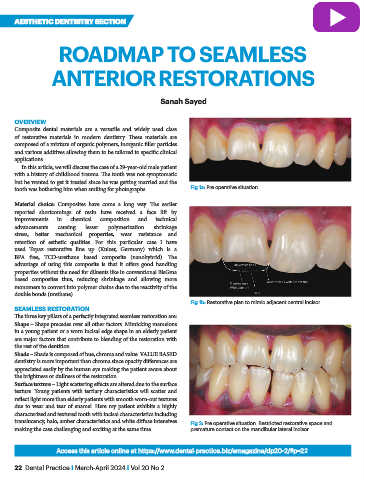
           tooth was bothering him when smiling for photographs.   Fig 1a: Pre operative situation

           Material choice: Composites have come a long way. The earlier
           reported shortcomings of resin have received a face lift by
           improvements  in  chemical  composition  and  technical
           advancements  causing  lesser  polymerization  shrinkage
           stress, better mechanical properties, wear resistance and
           retention of esthetic qualities. For this particular case I have
           used  Topaz  restorative  line  up  (Kulzer,  Germany)  which  is  a
           BPA free, TCD-urethane  based composite (nanohybrid). The
           advantage of using this composite is that it offers good handling
           properties without the need for diluents like in conventional BisGma
           based composites thus, reducing shrinkage and allowing more
           monomers to convert into polymer chains due to the reactivity of the
           double bonds (urethane).
                                                                   Fig 1b: Restorative plan to mimic adjacent central incisor
           SEAMLESS RESTORATION
           The three key pillars of a perfectly integrated seamless restoration are:
           Shape – Shape precedes over all other factors. Mimicking mamelons
           in a young patient or a worn incisal edge shape in an elderly patient
           are major factors that contribute to blending of the restoration with
           the rest of the dentition.
           Shade – Shade is composed of hue, chroma and value. VALUE BASED
           dentistry is more important than chroma since opacity differences are
           appreciated easily by the human eye making the patient aware about
           the brightness or dullness of the restoration.
           Surface texture – Light scattering effects are altered due to the surface
           texture. Young patients with tertiary characteristics will scatter and
           reflect light more than elderly patients with smooth worn-out textures
           due to wear and tear of enamel. Here my patient exhibits a highly
           characterized and textured tooth with incisal characteristics including
           translucency, halo, amber characteristics and white diffuse intensives   Fig 2: Pre operative situation. Restricted restorative space and
           making the case challenging and exciting at the same time.  premature contact on the mandibular lateral incisor.


                         Access this article online at https://www.dental-practice.biz/emagazine/dp20-2/#p=22

           22  Dental Practice I March-April 2024 I Vol 20 No 2

