


Page 23 - DP20-2.qxd
P. 23
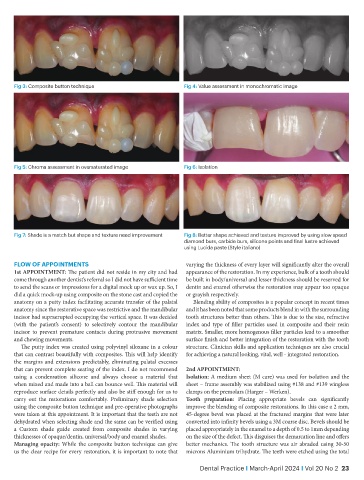
Fig 3: Composite button technique                      Fig 4: Value assessment in monochromatic image


           Fig 5: Chroma assessment in oversaturated image        Fig 6: Isolation


           Fig 7: Shade is a match but shape and texture need improvement   Fig 8: Better shape achieved and texture improved by using slow speed
                                                                  diamond burs, carbide burs, silicone points and final lustre achieved
                                                                  using Lucida paste (Style italiano)


           FLOW OF APPOiNTMENTS                                    varying the thickness of every layer will significantly alter the overall
           1st APPOINTMENT: The patient did not reside in my city and had   appearance of the restoration. In my experience, bulk of a tooth should
           come through another dentist’s referral so I did not have sufficient time   be built in body/universal and lesser thickness should be reserved for
           to send the scans or impressions for a digital mock up or wax up. So, I   dentin and enamel otherwise the restoration may appear too opaque
           did a quick mock-up using composite on the stone cast and copied the   or grayish respectively.
           anatomy on a putty index facilitating accurate transfer of the palatal   Blending ability of composites is a popular concept in recent times
           anatomy since the restorative space was restrictive and the mandibular   and it has been noted that some products blend in with the surrounding
           incisor had supraerupted occupying the vertical space. It was decided   tooth structures better than others. This is due to the size, refractive
           (with the patient’s  consent) to  selectively  contour the  mandibular   index and type of filler particles used in composite and their resin
           incisor to prevent premature contacts during protrusive movement   matrix. Smaller, more homogenous filler particles lead to a smoother
           and chewing movements.                                  surface finish and better integration of the restoration with the tooth
              The putty index was created using polyvinyl siloxane in a colour   structure. Clinician skills and application techniques are also crucial
           that can contrast beautifully with composites. This will help identify   for achieving a natural looking, vital, well - integrated restoration.
           the margins and extensions predictably, eliminating palatal excesses
           that can prevent complete seating of the index. I do not recommend   2nd APPOINTMENT:
           using a condensation silicone and always choose a material that   Isolation: A medium sheet (M care) was used for isolation and the
           when mixed and made into a ball can bounce well. This material will   sheet – frame assembly was stabilized using #138 and #139 wingless
           reproduce surface details perfectly and also be stiff enough for us to   clamps on the premolars (Harger – Werken).
           carry out the restorations comfortably. Preliminary shade selection   Tooth  preparation: Placing appropriate bevels can significantly
           using the composite button technique and pre-operative photographs   improve the blending of composite restorations. In this case a 2 mm,
           were taken at this appointment. It is important that the teeth are not   45-degree bevel was placed at the fractured margins that were later
           dehydrated when selecting shade and the same can be verified using   converted into infinity bevels using a 3M coarse disc. Bevels should be
           a Custom shade guide created from composite shades in varying   placed appropriately in the enamel to a depth of 0.5 to 1mm depending
           thicknesses of opaque/dentin, universal/body and enamel shades.   on the size of the defect. This disguises the demarcation line and offers
           Managing opacity: While the composite button technique can give   better mechanics. The tooth structure was air abraded using 30-50
           us the clear recipe for every restoration, it is important to note that   microns Aluminium trihydrate. The teeth were etched using the total

                                                                       Dental Practice i March-April 2024 i Vol 20 No 2  23

