


Page 36 - DP20-2.qxd
P. 36
AESTHETIC DENTISTRY SECTION


              DIGITAL CLINICAL COMMUNICATION


              WITH THE PATIENT DURING NATURAL


                   TEETH WHITENING PROCEDURES


                                               Prof. Dubravka Knezović Zlatarić


           Communication with the patient during dental procedures is an
           integral part of the protocol in everyday dental practice. When the
           patient arrives at the dental office, it’s not only to present the current
           problem, but also to show interest in the possible solutions we can offer.
           In addition to basic information related to the diagnosis, the patient
           is interested in the materials used, the course of their production,
           duration of the procedures and most importantly, the outcome of the
           procedure and the future appearance.
              We have seen an increase in the number of patients with esthetic
           deviations coming to our dental offices with the desire for their
           correction, even though they have completely intact, healthy teeth.
           If there is an indication in such a case, it is necessary to perform
           minimally  invasive  procedures  in  which  the  esthetic  deviations
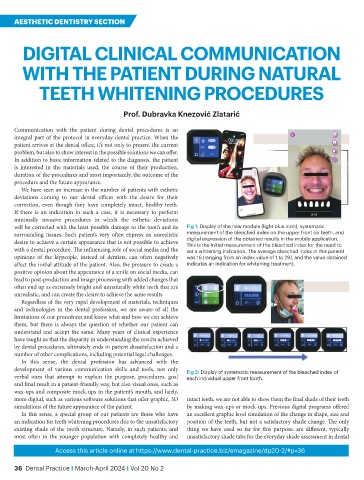
           will be corrected with the least possible damage to the tooth and its   Fig 1: Display of the new module (light blue icon), systematic
           surrounding tissues. Such patients very often express an unrealistic   measurement of the bleached index on the upper front six teeth, and
           desire to achieve a certain appearance that is not possible to achieve   digital expression of the obtained results in the mobile application.
                                                                   This is the initial measurement of the bleached index for the need to
           with a dental procedure. The influencing role of social media and the   set a whitening indication. The average bleached index in this patient
           opinions of the laypeople, instead of dentists, can often negatively   was 16 (ranging from an index value of 1 to 29), and the value obtained
           affect the initial attitude of the patient. Also, the pressure to create a   indicates an indication for whitening treatment.
           positive opinion about the appearance of a smile on social media, can
           lead to post-production and image processing with added changes that
           often end up as extremely bright and unnaturally white teeth that are
           unrealistic, and can create the desire to achieve the same results.
              Regardless of the very rapid development of materials, techniques
           and technologies in the dental profession, we are aware of all the
           limitations of our procedures and know what and how we can achieve
           them, but there is always the question of whether our patient can
           understand and accept the same. Many years of clinical experience
           have taught us that the disparity in understanding the results achieved
           by dental procedures, ultimately ends in patient dissatisfaction and a
           number of other complications, including potential legal challenges.
              In this sense, the dental profession has advanced with the
           development of various communication skills and tools, not only   Fig 2: Display of systematic measurement of the bleached index of
           verbal ones that attempt to explain the purpose, procedures, goal   each individual upper front tooth.
           and final result in a patient-friendly way, but also visual ones, such as
           wax-ups and composite mock-ups in the patient’s mouth, and lately,
           more digital, such as various software solutions that offer graphic, 3D   intact teeth, we are not able to show them the final shade of their teeth
           simulations of the future appearance of the patient.    by making wax-ups or mock-ups. Previous digital programs offered
              In this sense, a special group of our patients are those who have   an excellent graphic level simulation of the change in shape, size and
           an indication for teeth whitening procedures due to the unsatisfactory   position of the teeth, but not a satisfactory shade change. The only
           existing shade of the tooth structure. Namely, in such patients, and   thing we have used so far for this purpose, are different, typically
           most often in the younger population with completely healthy and   unsatisfactory shade tabs for the everyday shade assessment in dental

                         Access this article online at https://www.dental-practice.biz/emagazine/dp20-2/#p=36

           36  Dental Practice I March-April 2024 I Vol 20 No 2

