


Page 54 - DP Vol 20 No 3
P. 54
Implant dentIstry  sectIon


                         GUIDED IMPLANT SURGERY AND


             PROSTHESES DELIVERY WITH STACKABLE


              TEMPLATES IN FULL DIGITAL WORKFLOW


                    Guided surgery techniques in implantology have been available for many years.
                 Despite this, their adoption has been limited, and the percentage of implants inserted
                                     using guided surgery procedures remains limited.


                                               Carlo E. Poggio, Mario Zangarini


           In clinical conditions such as completely edentulous arches or
           partially edentulous areas where teeth cannot be used for prosthetic
           purposes, guided surgery offers theoretical advantages. These include
           the ability to design implant positioning three-dimensionally and to
           create prosthetic structures in coordination with implant placement.
           However, these advantages have often been overshadowed by practical
           limitations in the eyes of many clinicians.
              The resin templates typically used in guided surgery can create
           problematic dimensions due to their bulk, limiting surgical accessibility
           to the implant sites. This restriction makes guided surgery primarily
           feasible in cases with abundant keratinized tissue and favourable bone
           conditions—situations where a “flapless” approach is viable. Ironically,
           these straightforward cases are also manageable with conventional
           techniques.
              Conversely, more complex clinical scenarios—such as those with
           limited bone volumes, scarce keratinized tissue, and the need for
           additional surgical procedures like extractions, flap repositioning,
           and bone defect filling—pose significant challenges for the guided
           approach.  The  margin  of  error  in  implant  positioning  with  guided
           surgery, combined with the difficulties of managing traditional
           closed resin templates, often complicates treatment in these non-
           ideal clinical situations. Thus, guided surgery has paradoxically been
           more applicable in simpler cases, where its benefits are less critical,
           and less achievable in more complex situations, where it could be most
           beneficial.
              In addition to these limitations, the higher costs associated with the
           procedure (including software, jig production, and dedicated bur kits)
           necessitate further evaluation of clinical convenience. For the higher
           cost of guided surgery to be justified, it must offer tangible advantages.
              In recent years, various methods have been developed to overcome
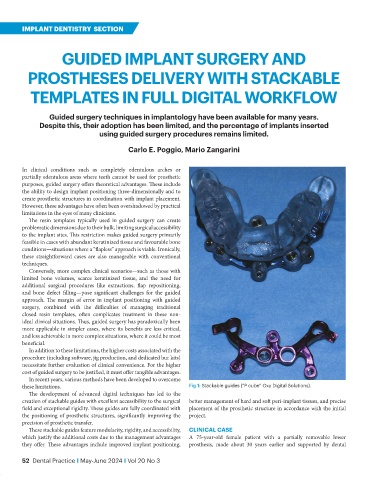
           these limitations.                                      Fig 1: Stackable guides (“P cube” Oxy Digital Solutions).
              The  development  of  advanced  digital  techniques  has  led  to  the
           creation of stackable guides with excellent accessibility to the surgical   better management of hard and soft peri-implant tissues, and precise
           field and exceptional rigidity. These guides are fully coordinated with   placement of the prosthetic structure in accordance with the initial
           the positioning of prosthetic structures, significantly improving the   project.
           precision of prosthetic transfer.
              These stackable guides feature modularity, rigidity, and accessibility,   CLINICAL CASE
           which justify the additional costs due to the management advantages   A 75-year-old female patient with a partially removable lower
           they offer. These advantages include improved implant positioning,   prosthesis,  made  about  30  years  earlier  and  supported  by  dental

           52  Dental Practice I May-June 2024 I Vol 20 No 3

