


Page 26 - DP Vol 20 No 4 HR
P. 26
ORTHODONTIC  SECTION


                      TRANSFORMATIVE TREATMENT:


            ORTHO AND ORTHOGNATHIC SURGERY


                                         Shivani Patel, Paul Johnson and Raul Costa

                 The authors present their transformative treatment case, an award-winning case from
                                             Dentistry Clinical Case Awards 2022


           INTRODUCTION                                           Table 1: Extraoral Assessment
           This patient was initially referred to the clinic at the age of 13, as her
           parents were concerned about her speech—she had a lisp and was
           still sucking her thumb. They also noticed that she was struggling to
           bite with her front teeth.
              While living in the US, she experienced bullying at school, with
           other children mocking her for having ‘weird teeth.’ At the age of six,
           while still in the US, she was treated with a palatal expander and full
           fixed braces.
              When  the family  moved to the UK, they  sought  a second
           orthodontic opinion. Since the patient was a very shy and introverted
           girl, the family was worried she might face bullying in the UK as well.
              This case highlights her orthodontic/orthognathic treatment,
           which began when she was 17 years old.

           ASSESSMENT
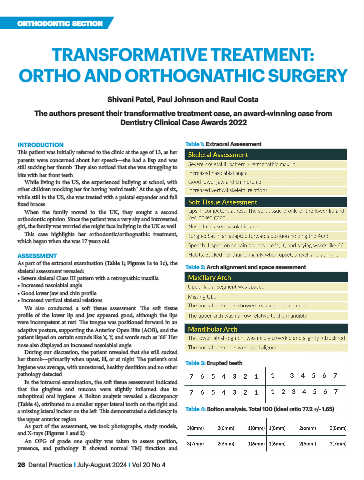
           As part of the extraoral examination (Table 1; Figures 1a to 1c), the
           skeletal assessment revealed:                          Table 2: Arch alignment and space assessment
           • Severe skeletal Class III pattern with a retrognathic maxilla
           • Increased nasolabial angle
           • Good lower jaw and chin profile
           • Increased vertical skeletal relations
              We also conducted a soft tissue assessment. The soft tissue
           profile of the lower lip and jaw appeared good, although the lips
           were incompetent at rest. The tongue was positioned forward in an
           adaptive posture, supporting the Anterior Open Bite (AOB), and the
           patient lisped on certain sounds like ‘s’, ‘f,’ and words such as ‘66’. Her
           nose also displayed an increased nasolabial angle.
              During our discussion, the patient revealed that she still sucked
           her thumb—primarily when upset, ill, or at night. The patient’s oral   Table 3: Erupted teeth
           hygiene was average, with unrestored, healthy dentition and no other
           pathology detected.
              In the intraoral examination, the soft tissue assessment indicated
           that  the  gingivae  and  mucosa  were  slightly  inflamed  due  to
           suboptimal oral hygiene. A Bolton analysis revealed a discrepancy
           (Table 4), attributed to a smaller upper lateral tooth on the right and
           a missing lateral incisor on the left. This demonstrated a deficiency in   Table 4: Bolton analysis. Total 100 (ideal ratio 77.2 +/- 1.65)
           the upper anterior region.
              As part of the assessment, we took photographs, study models,
           and X-rays (Figures 1 and 2).
              An OPG of grade one quality was taken to assess position,
           presence, and pathology. It showed normal TMJ function and

           26  Dental Practice I July-August 2024 I Vol 20 No 4

