


Page 50 - DP Vol 20 No 4 HR
P. 50
IMPLANT DENTISTRY SECTION


            RESTORING FRACTURED MAXILLARY ANTERIOR

                       TOOTH BY EARLY LOADING OF SINGLE


                  TRABECULAR IMPLANT WITH A CHAIRSIDE


                CROWN PLACEMENT ON TI-BASE ABUTMENT


                              AFTER 15 DAYS: A CASE REPORT


                                  Gaurav Gupta, D. K. Gupta, Richa Gupta, Neelja Gupta


           INTRODUCTION
           Dental implants have been used in clinical practice for nearly
           three decades and are widely accepted as a viable treatment
           option for edentulous patients.  Today, with advancements in
                                  [1]
           implant surface treatments, osseointegration is regarded as a
           predictable biological process. However, while osseointegration
           is crucial, it does not necessarily ensure patient satisfaction,
           particularly in the aesthetic region.  The success of dental
                                       [2]
           implant treatments hinges on both functional and aesthetic
           outcomes. Smith and Zarb emphasized this by asserting that a
           successful implant must not only function well but also meet
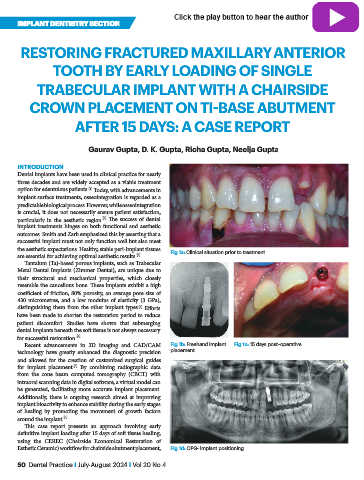
           the aesthetic expectations. Healthy, stable peri-implant tissues   Fig 1a: Clinical situation prior to treatment
           are essential for achieving optimal aesthetic results. [2]
              Tantalum (Ta)-based porous implants, such as Trabecular
           Metal Dental Implants (Zimmer Dental), are unique due to
           their structural  and mechanical  properties, which  closely
           resemble the cancellous bone. These implants exhibit a high
           coefficient of friction, 80% porosity, an average pore size of
           430 micrometres, and a low modulus of elasticity (3 GPa),
           distinguishing them from the other implant types.  Efforts
                                                   [3]
           have been made to shorten the restoration period to reduce
           patient discomfort. Studies have shown that submerging
           dental implants beneath the soft tissue is not always necessary
           for successful restoration. [4]
              Recent advancements in 3D  imaging and CAD/CAM   Fig 1b: Freehand implant   Fig 1c: 15 days post–operative
           technology have greatly enhanced the diagnostic precision   placement
           and allowed for the creation of customized surgical guides
           for  implant  placement.   By  combining  radiographic  data
                              [5]
           from the cone beam computed tomography (CBCT) with
           intraoral scanning data in digital software, a virtual model can
           be generated, facilitating more accurate implant placement.
           Additionally, there is ongoing research aimed at improving
           implant bioactivity to enhance stability during the early stages
           of healing by promoting the movement of growth factors
           around the implant. [6]
              This case report presents an approach involving early
           definitive implant loading after 15 days of soft tissue healing,
           using the CEREC (Chairside Economical Restoration of
           Esthetic Ceramic) workflow for chairside abutment placement,   Fig 1d: OPG- Implant positioning

           50  Dental Practice I July-August 2024 I Vol 20 No 4

