


Page 54 - DP Vol 20 No 4 HR
P. 54
ORTHODONTIC SECTION


                  CUSTOMIZED NOVEL APPLIANCE FOR


                INDIVIDUAL TOOTH MOVEMENT IN THE


                 ERA OF INVISIBLE ORTHODONTICS: AN


                                                    OVERVIEW


                            Shakfi Rahman, Sana Bint Aziz, Ashish Kumar Singh, Puneet Batra


           INTRODUCTION
           Recent advancements in orthodontics focus on enhancing the
           standards of orthodontic practices, through ingenious technologies.
                                                               1
           Major developments in the past two decades include embracing the
           computer-aided design and manufacturing (CAD/CAM), digital
           scanning, and 3D printing.  These technologies have significantly
                                 2
           impacted orthodontics, beginning with virtual treatment planning and
           3D scanning.  Initially applied to clear aligners and indirect bonding
                     3
           systems, these tools have enabled more precise and customised
           orthodontic treatments. 4
              The incorporation of precision digital orthodontics has transformed
           various appliances . Clear aligners, for instance, offer an aesthetic
                          5
           alternative to traditional  labial fixed appliances and have grown in
           popularity due to their changeable nature, which reduces risks such
           as white spot lesions and root resorption.  They also minimize
                                              6,7
           the frequency of dental clinic visits and chair time. However, clear
           aligners require patient compliance and are less productive for certain
           movements, such as rotations and extrusions. 8
              The advent of 3D-printed brackets has enhanced labial fixed
           appliances by providing a more customized solution for each tooth,
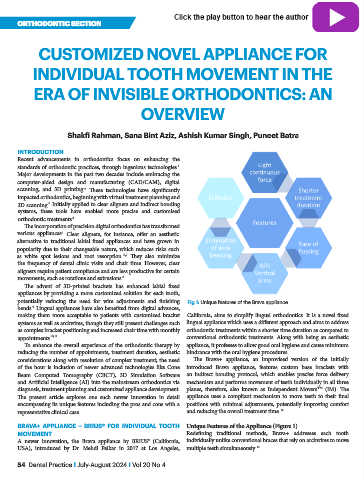
           potentially reducing the need for wire adjustments and finishing   Fig 1: Unique features of the Brava appliance
           bends.  Lingual appliances have also benefited from digital advances,
                9
           making them more acceptable to patients with customized bracket   California, aims to simplify lingual orthodontics. It is a novel fixed
           systems as well as archwires, though they still present challenges such   lingual appliance which uses a different approach and aims to address
           as complex bracket positioning and increased chair time with monthly   orthodontic treatments within a shorter time duration as compared to
           appointments .10,11                                    conventional orthodontic treatments. Along with being an aesthetic
              To enhance the overall experience of the orthodontic therapy by   appliance, it professes to allow good oral hygiene and cause minimum
           reducing the number of appointments, treatment duration, aesthetic   hindrance with the oral hygiene procedures.
           considerations along with resolution of complex treatment; the need   The Brava+ appliance, an improvised version of the initially
           of the hour is inclusion of newer advanced technologies like Cone   introduced  Brava  appliance,  features  custom  base  brackets  with
           Beam Computed Tomography (CBCT), 3D Simulation Software   an indirect bonding protocol, which enables precise force delivery
           and Artificial Intelligence (AI) into the mainstream orthodontics via   mechanism and performs movement of teeth individually in all three
           diagnosis, treatment planning and customized appliance development.   planes, therefore, also known as Independent Movers  (IM). The
                                                                                                             TM
           The present article explores one such newer innovation in detail   appliance uses a compliant mechanism to move teeth to their final
           encompassing its unique features including the pros and cons with a   positions with minimal adjustments, potentially improving comfort
           representative clinical case.                          and reducing the overall treatment time. 12

           BRAVA+ APPLIANCE – BRIUS® FOR INDIVIDUAL TOOTH  Unique Features of the Appliance (Figure 1)
           MOVEMENT                                               Redefining traditional methods, Brava+ addresses each tooth
           A newer innovation, the Brava appliance by BRIUS® (California,   individually unlike conventional braces that rely on archwires to move
           USA), introduced by Dr. Mehdi Peikar in 2017 at Los Angeles,   multiple teeth simultaneously. 13

           54  Dental Practice I July-August 2024 I Vol 20 No 4

