


Page 18 - DP20-2.qxd
P. 18
implantology section


              BOUND DOWN SOFT TISSUE AND THE


                CRESTAL SOFT TISSUE COMPLEX IN


                   IMPLANT DENTISTRY- AN INSIGHT


                                                         Yazad Gandhi

           When rehabilitating a patient with dental implants, we often notice
           soft tissue deficiencies in quality and/or quantity. The development
           of a sufficient peri-implant soft tissue cuff plays a significant role in
           influencing the long-term stability of the surrounding bone and soft
           tissues, as well as the seamless emergence of the superstructure into
           the oral environment. This also contributes to establishing a condition
           free of inflammation over the long term. Although numerous studies
           over the years have proven that keratinized tissue around an implant
           is essential to enhance the protective environment for the crestal bone,
           Wennström et al suggested that further research is required to explore
           the importance of keratinized tissue around implants and determine
           the precise amount of soft tissue necessary to effectively prevent peri-
           implant disease.
              The controversy about the need for a keratinized (attached)
           gingival zone around implant-supported restorations is a topic for
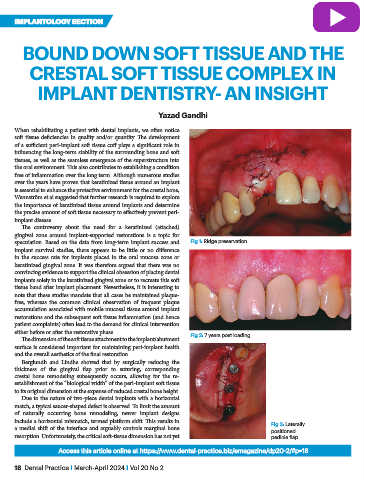
           speculation. Based on the data from long-term implant success and   Fig 1: Ridge preservation
           implant survival studies, there appears to be little or no difference
           in the success rate for implants placed in the oral mucosa zone or
           keratinized gingival zone. It was therefore argued that there was no
           convincing evidence to support the clinical obsession of placing dental
           implants solely in the keratinized gingival zone or to recreate this soft
           tissue band after implant placement. Nevertheless, it is interesting to
           note that these studies mandate that all cases be maintained plaque-
           free, whereas the common clinical observation of frequent plaque
           accumulation associated with mobile mucosal tissue around implant
           restorations and the subsequent soft tissue inflammation (and hence
           patient complaints) often lead to the demand for clinical intervention
           either before or after the restorative phase.           Fig 2: 7 years post loading
              The dimension of the soft tissue attachment to the implant/abutment
           surface is considered important for maintaining peri-implant health
           and the overall aesthetics of the final restoration.
              Berglundh and Lindhe showed that by surgically reducing the
           thickness of the gingival flap prior to suturing, corresponding
           crestal bone remodeling subsequently occurs, allowing for the re-
           establishment of the “biological width” of the peri-implant soft tissue
           to its original dimension at the expense of reduced crestal bone height.
              Due to the nature of two-piece dental implants with a horizontal
           match, a typical saucer-shaped defect is observed. To limit the amount
           of naturally occurring bone remodeling, newer implant designs
           include a horizontal mismatch, termed platform shift. This results in             Fig 3: Laterally
           a medial shift of the interface and arguably controls marginal bone               positioned
           resorption. Unfortunately, the critical soft-tissue dimension has not yet         pedicle flap

                         Access this article online at https://www.dental-practice.biz/emagazine/dp20-2/#p=18

           18  Dental Practice I March-April 2024 I Vol 20 No 2

