


Page 20 - DP20-2.qxd
P. 20
implantology section


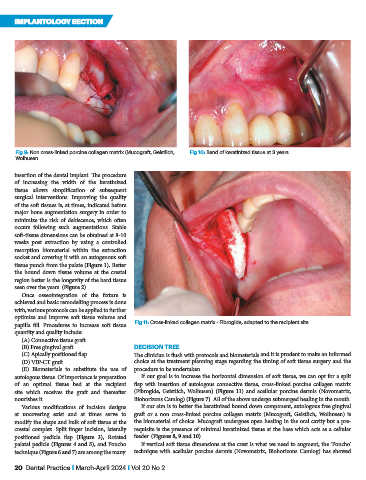
           Fig 9: Non cross-linked porcine collagen matrix (Mucograft, Geistlich,   Fig 10: Band of keratinized tissue at 3 years
           Wolhusen


           insertion of the dental implant. The procedure
           of increasing the width of the keratinized
           tissue allows simplification of subsequent
           surgical interventions. Improving the quality
           of the soft tissues is, at times, indicated before
           major bone augmentation surgery in order to
           minimize the risk of dehiscence, which often
           occurs following such augmentations. Stable
           soft-tissue dimensions can be obtained at 8-10
           weeks post extraction by using a controlled
           resorption  biomaterial  within  the  extraction
           socket and covering it with an autogenous soft
           tissue punch from the palate (Figure 1). Better
           the bound down tissue volume at the crestal
           region better is the longevity of the hard tissue
           seen over the years. (Figure 2)
              Once osseointegration of the fixture is
           achieved and basic remodelling process is done
           with, various protocols can be applied to further
           optimize and improve soft tissue volume and
           papilla fill. Procedures to increase soft tissue   Fig 11: Cross-linked collagen matrix - Fibrogide, adapted to the recipient site
           quantity and quality include:
              (A) Connective tissue graft
              (B) Free gingival graft             DECISION TREE
              (C) Apically positioned flap        The clinician is flush with protocols and biomaterials and it is prudent to make an informed
              (D) VIP-CT graft                    choice at the treatment planning stage regarding the timing of soft tissue surgery and the
              (E) Biomaterials to substitute the use of   procedure to be undertaken.
           autologous tissue. Of importance is preparation   If our goal is to increase the horizontal dimension of soft tissue, we can opt for a split
           of an optimal tissue bed at the recipient   flap with insertion of autologous connective tissue, cross-linked porcine collagen matrix
           site which receives the graft and thereafter   (Fibrogide, Geistlich, Wolhusen)  (Figure 11)  and acellular  porcine dermis (Novomatrix,
           nourishes it.                          Biohorizons Camlog) (Figure 7). All of the above undergo submerged healing in the mouth.
              Various  modifications of incision designs   If our aim is to better the keratinized bound down component, autologous free gingival
           at uncovering exist and at times serve to   graft or a non cross-linked porcine collagen matrix (Mucograft, Geistlich, Wolhusen) is
           modify the shape and bulk of soft tissue at the   the biomaterial of choice. Mucograft undergoes open healing in the oral cavity but a pre-
           crestal  complex. Split  finger incision, laterally   requisite is the presence of minimal keratinized tissue at the base which acts as a cellular
           positioned pedicle flap  (Figure 3), Rotated   feeder. (Figures 8, 9 and 10)
           palatal pedicle (Figures 4 and 5), and Poncho   If vertical soft tissue dimensions at the crest is what we need to augment, the ‘Poncho’
           technique (Figure 6 and 7) are among the many.  technique with acellular porcine dermis (Novomatrix, Biohorizons Camlog) has showed

           20  Dental Practice I March-April 2024 I Vol 20 No 2

