


Page 36 - DP Vol 20 No 4 HR
P. 36
IMPLANT DENTISTRY SECTION


                                                                   with thin biotype mucosa. Multiple abutment screwing-unscrewing
                                                                   sequences have been linked to bone loss and shown to impact the
                                                                   oral mucosa barrier [15–17] . A meta-analysis conducted by Koutouzis T
                                                                   et al.  demonstrated that, although other research outcomes were
                                                                       [18]
                                                                   controversial, repeated screwing and unscrewing does cause marginal
                                                                   bone loss.
                                                                     In this clinical instance, CBCT imaging performed a year after
                                                                   prosthesis placement  revealed  stable  bone  levels  surrounding  the
                                                                   dental implants without any remodelling of the bone around the
                                                                   implants.  Additionally,  implants  were  used  in  conjunction  with
                                                                   a platform-switching system and a conical hexagonal connector.
                                                                   Multiunit abutments can be installed intraoperatively at the time of
                                                                   implant placement, sealing the implant neck and forming a wider,
                                                                   stronger, and newer hemidesmosomal attachments at the multiunit
                                                                   abutment neck level. All manipulations for replacing the prosthesis
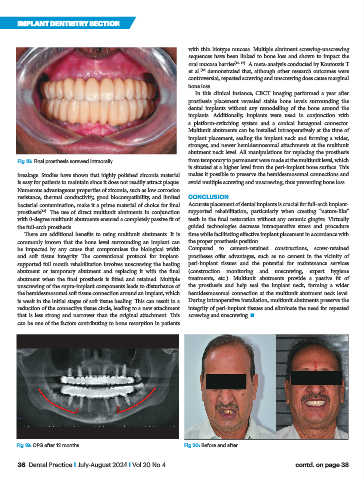
           Fig 18: Final prosthesis screwed intraorally            from temporary to permanent were made at the multiunit level, which
                                                                   is situated at a higher level from the peri-implant bone surface. This
           breakage. Studies have shown that highly polished zirconia material   makes it possible to preserve the hemidesmosomal connections and
           is easy for patients to maintain since it does not readily attract plaque.   avoid multiple screwing and unscrewing, thus preventing bone loss.
           Numerous advantageous properties of zirconia, such as low corrosion
           resistance, thermal conductivity, good biocompatibility, and limited   CONCLUSION
           bacterial contamination, make it a prime material of choice for final   Accurate placement of dental implants is crucial for full-arch implant-
           prosthesis . The use of direct multiunit abutments in conjunction   supported rehabilitation,  particularly  when  creating  “nature-like”
                   [14]
           with 0-degree multiunit abutments ensured a completely passive fit of   teeth in the final restoration without any ceramic gingiva. Virtually
           the full-arch prosthesis.                               guided technologies  decrease intraoperative stress and procedure
              There are additional benefits to using multiunit abutments. It is   time while facilitating effective implant placement in accordance with
           commonly known that the bone level surrounding an implant can   the proper prosthesis position.
           be  impacted  by any cause that compromises the  biological width   Compared to cement-retained constructions, screw-retained
           and soft tissue integrity. The conventional protocol for implant-  prostheses offer advantages, such as no cement in the vicinity of
           supported full mouth rehabilitation involves unscrewing the healing   peri-implant tissues and the potential for maintenance services
           abutment or temporary abutment and replacing it with the final   (construction monitoring and unscrewing, expert hygiene
           abutment when the final prosthesis is fitted and retained. Multiple   treatments, etc.). Multiunit abutments  provide a  passive fit  of
           unscrewing of the supra-implant components leads to disturbance of   the  prosthesis  and  help  seal  the  implant  neck,  forming  a  wider
           the hemidesmosomal soft tissue connection around an implant, which   hemidesmosomal connection at the multiunit abutment neck level.
           is weak in the initial stages of soft tissue healing. This can result in a   During intraoperative installation, multiunit abutments preserve the
           reduction of the connective tissue circle, leading to a new attachment   integrity of peri-implant tissues and eliminate the need for repeated
           that is less strong and narrower than the original attachment. This   screwing and unscrewing. n
           can be one of the factors contributing to bone resorption in patients


           Fig 19: OPG after 12 months                            Fig 20: Before and after

           36  Dental Practice I July-August 2024 I Vol 20 No 4                                       contd. on page 38

