


Page 57 - DP Vol 20 No 4 HR
P. 57
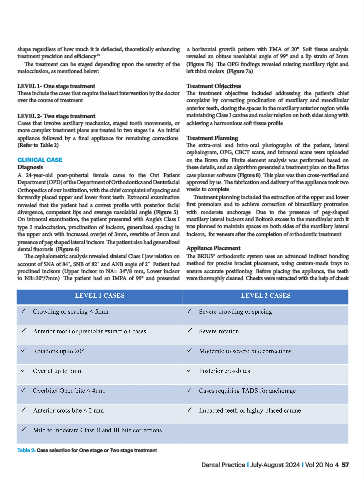
shape regardless of how much it is deflected, theoretically enhancing   a horizontal growth pattern with FMA of 20°. Soft tissue analysis
           treatment precision and efficiency. 13                 revealed an obtuse nasolabial angle of 99° and a lip strain of 3mm
              The treatment can be staged depending upon the severity of the   (Figure 7b). The OPG findings revealed missing maxillary right and
           malocclusion, as mentioned below:                      left third molars. (Figure 7a)

           LEVEL 1- One stage treatment                           Treatment Objectives
           These include the cases that require the least intervention by the doctor   The treatment objectives included addressing the patient’s chief
           over the course of treatment.                          complaint by correcting proclination of maxillary and mandibular
                                                                  anterior teeth, closing the spaces in the maxillary anterior region while
           LEVEL 2- Two stage treatment                           maintaining Class I canine and molar relation on both sides along with
           Cases that involve auxiliary mechanics, staged tooth movements, or   achieving a harmonious soft tissue profile.
           more complex treatment plans are treated in two stages i.e. An initial
           appliance followed by a final appliance for remaining corrections.  Treatment Planning
           (Refer to Table 2)                                     The  extra-oral and  intra-oral  photographs of the  patient,  lateral
                                                                  cephalogram, OPG, CBCT scans, and intraoral scans were uploaded
           CLINICAL CASE                                          on the Brava site. Finite element analysis was performed based on
           Diagnosis                                              these details, and an algorithm generated a treatment plan on the Brius
           A 24-year-old post-pubertal female came to the Out Patient   case planner software (Figure 8). This plan was then cross-verified and
           Department (OPD) of the Department of Orthodontics and Dentofacial   approved by us. The fabrication and delivery of the appliance took two
           Orthopedics of our institution, with the chief complaint of spacing and   weeks to complete.
           forwardly placed upper and lower front teeth. Extraoral examination   Treatment planning included the extraction of the upper and lower
           revealed  that the patient had  a convex  profile  with  posterior facial   first premolars and to achieve correction of bimaxillary protrusion
           divergence, competent lips and average nasolabial angle (Figure 5).   with moderate anchorage. Due to the presence of peg-shaped
           On intraoral examination, the patient presented with Angle’s Class I   maxillary lateral incisors and Bolton’s excess in the mandibular arch it
           type 2 malocclusion, proclination of incisors, generalized spacing in   was planned to maintain spaces on both sides of the maxillary lateral
           the upper arch with increased overjet of 3mm, overbite of 3mm and   incisors,  for veneers after the completion of orthodontic treatment.
           presence of peg shaped lateral incisors. The patient also had generalized
           dental fluorosis. (Figure 6)                           Appliance Placement
              The cephalometric analysis revealed skeletal Class I jaw relation on   The BRIUS® orthodontic system uses an advanced indirect bonding
           account of SNA of 84˚, SNB of 82˚ and ANB angle of 2˚. Patient had   method  for precise bracket  placement,  using custom-made  trays  to
           proclined incisors (Upper incisor to NA= 34°/8 mm, Lower incisor   ensure accurate positioning. Before  placing the  appliance, the  teeth
           to NB=30°/7mm). The patient had an IMPA of 99° and presented   were thoroughly cleaned. Cheeks were retracted with the help of cheek


           Table 2: Case selection for One stage or Two stage treatment
                                                                       Dental Practice I July-August 2024 I Vol 20 No 4  57

